Ever wondered how to protect something so sensitive—like a master encryption key or a vault code—that you can’t trust it to just one person, but you also can’t risk losing it forever if a single computer crashes?
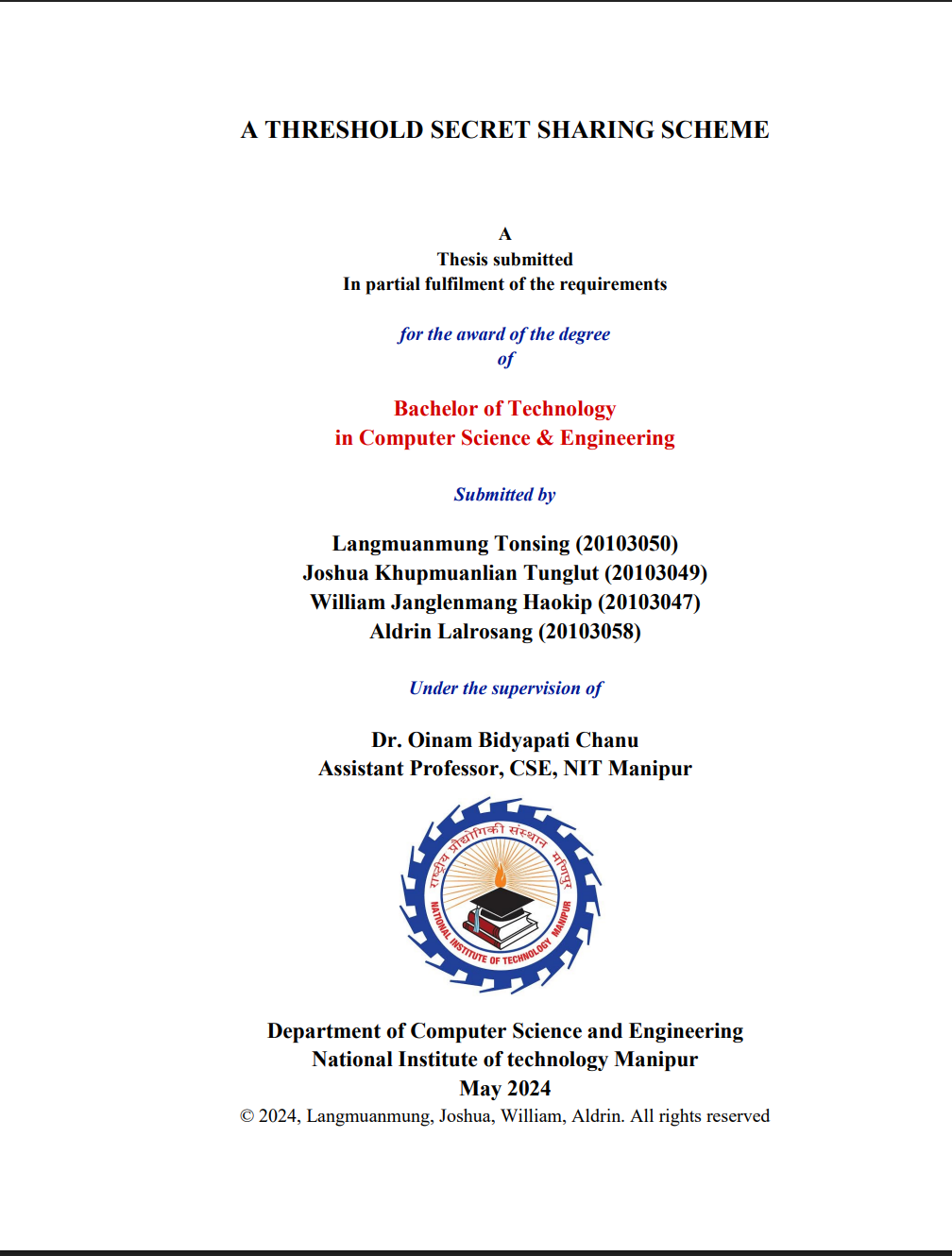
For my B.Tech thesis at NIT Manipur, my team and I dove into the world of (k, n) Threshold Secret Sharing Schemes.
The Concept is Simple but Powerful: Instead of hiding one key in one place, you split that secret into “n” different pieces (shares) and distribute them among a group.
-
The Magic Number (k): You only need a specific minimum number of people (k) to come together to unlock the secret.
-
Total Security: If anyone has fewer than k pieces, they have absolutely zero information about the original secret. It’s mathematically impossible to crack without enough partners.
Why This Matters:
-
Vault Security: No single executive can open the company vault alone; they need their colleagues to “agree” by providing their shares.
-
Digital Democracy: It can secure voting systems by ensuring votes are only tallied when a threshold of authorities is present.
-
Peace of Mind: Even if half your data is destroyed or stolen, your secret remains both accessible to you and hidden from your enemies.
What We Built: We implemented a robust version of this using Java and Lagrange Interpolation. By treating the secret as a point on a mathematical curve, we can reconstruct the entire “map” only when enough points are provided.
A THRESHOLD SECRET SHARING SCHEME GROUP 6 2024.pdf (810.3 KB)